
Dear Investor:
This week, we wanted to take a closer look at the industry in which All Your Meals operates and some of the broader market trends shaping the prepared-meal business.
Over the past decade, the prepared-meal industry has evolved considerably. What was once largely associated with frozen supermarket dinners (aka TV dinners) has developed into a much broader food category encompassing fresh prepared meals, premium ready-to-eat products, meal subscriptions, direct-to-consumer delivery and specialized meal-preparation services.
Changing lifestyles, demand for convenience, rising food costs and the desire to spend less time preparing meals have all contributed to the development of this market. This is not a generational only phenomenon; it crosses all ages groups.
An Industry Measured in Billions
The broader ready-meal category represents a substantial market in both North America and internationally.
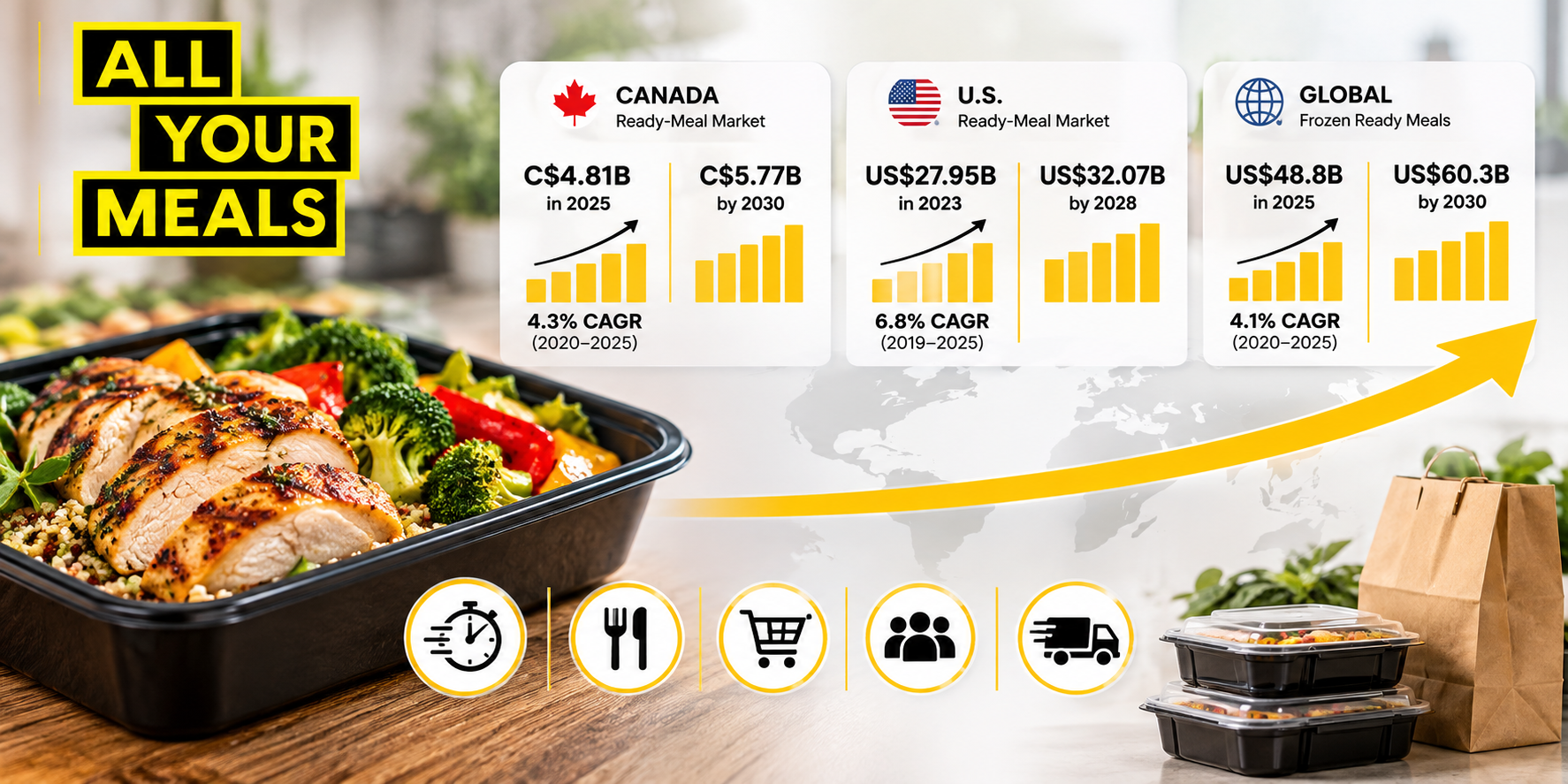
According to Agriculture and Agri-Food Canada, drawing on research from Euromonitor International, the Canadian ready-meal market generated approximately C$4.81 billion in retail sales in 2025. This represents annualized growth of 4.3% between 2020 and 2025. The market is projected to reach approximately C$5.77 billion by 2030.
In the United States, ready-meal retail sales reached approximately US$27.95 billion in 2023. The category experienced annualized growth of 6.8% between 2019 and 2023, with sales projected to reach approximately US$32.07 billion by 2028.
The global market is also substantial with sales that reached approximately US$48.8 billion in 2025, with projections indicating growth to approximately US$60.3 billion by 2030.
While these figures encompass broader retail ready-meal categories, rather than exclusively direct-to-consumer meal-preparation businesses, they illustrate the established scale of the industry and the continuing demand for convenient food solutions.
What Is Driving Demand?
Several consumer trends are contributing to the development of the prepared-meal industry. We see many of these trend by just dining out and ordering in ourselves.
Convenience and Time Savings - Modern consumers increasingly look for practical alternatives to preparing every meal from scratch. Work schedules, commuting, family responsibilities and changing lifestyles have contributed to demand for meals that require minimal preparation. And let's face it. A lot of people are really terrible when it comes to cooking. I was "with" someone who lived on frozen dinners before I met her and who actually burned a pot just boiling water. True story.
Food Quality and Variety - Convenience alone is no longer the only consideration. Consumers increasingly expect variety, quality ingredients and interesting menu selections. Globally inspired meals and restaurant-style dishes have helped broaden the appeal of prepared food. And who hasn't been channel surfing or doom scrolling and stopped at a cooking show or contest? We see really cool food being made and we want to try it. Just not cook it.
The Cost of Eating Out - Prepared meals can offer an alternative to restaurant dining and food delivery. Tip fatigue is real. How did going to McDonalds for lunch suddenly cost $20? For consumers looking to manage household food expenses while maintaining convenience, ready-made meals occupy an interesting position between traditional grocery shopping and eating out.
Changing Purchasing Habits - Online ordering and direct-to-consumer distribution have created additional ways for food businesses to reach customers. Recurring ordering models also provide opportunities to develop ongoing customer relationships and establish more predictable purchasing patterns. Recurring revenue...subscription business model...that's us!
These trends are helping shape how consumers approach everyday meals and how our team organizes our products, production and distribution.
Why the Business Model Matters
Although consumer demand is an important part of the industry, our business involves considerably more than simply producing and selling food.
Production capacity, ingredient sourcing, labour, packaging, inventory management and quality control all contribute to the underlying economics of the business.
Distribution is another significant factor. For many of our competitor, the economics of delivering prepared meals can vary considerably depending on geographic coverage, order volumes, delivery routes and the proximity of production facilities to customers. We are ready to roll out a solution using 3PL to overnight ship across the USA. Yup. We are.
And marketing. We have been steadily building our brand and the things that's gonna drive new sales? Advertising. The thing that's gonna drive repeat customers? Amazing food and exceptional customer service.
Ultimately, food quality, convenience and operational consistency must work together.
And that's where we win. Because we have being doing this for a while now and are ready to scale.
Looking Ahead
As part of Tritent International Corp.'s operating business through Super Fresh Foods Inc., All Your Meals participates in a food category that has developed well beyond traditional prepared grocery products.
Our company combines food production, technology, customer acquisition, inventory management and distribution. Each of these elements plays a role in the operation of a prepared-meal business.
We believe it is useful for shareholders to understand not only the business itself, but also the industry fundamentals and consumer trends that influence the sector.
Thank you for your continued support of All Your Meals and if you have any questions or comments, please feel free to reach out to us.
All Your Meals Inc.
Patrick Smyth
Corporate Finance & Creative Director
A Tritent International Corp. (OTCID: TICJ) Company
allyourmeals.com | company.allyourmeals.com
Industry statistics are based on retail market estimates and forecasts from Euromonitor International, as reported by Agriculture and Agri-Food Canada.
This communication may contain forward-looking statements concerning anticipated plans, strategies, market opportunities and future operations. Actual results may differ materially due to risks and uncertainties, including market acceptance, competition, technology development, customer acquisition, operational challenges and other factors affecting the business of Tritent International Corp., Super Fresh Foods Inc. and All Your Meals Inc. There can be no assurance that anticipated opportunities or objectives will be achieved. Tritent International Corp., Super Fresh Foods Inc. and All Your Meals Inc. undertake no obligation to update forward-looking statements except as required by applicable law.